How to Register a Company in Thailand: Step-by-Step Guide (2026)
Register a company in Thailand in 2026. Step-by-step guide covering DBD Biz Regist, fees, foreign ownership rules, and timelines from Plizz.

Company registration in Thailand changed more in 2026 than it has in the previous five years combined. On 1 January 2026, the Department of Business Development (DBD) made its new DBD Biz Regist platform the only legal way to incorporate a private limited company. Paper filings and walk-in registration counters are gone. At the same time, eight service activities have been exempted from the Foreign Business Act’s licensing requirement, and the rules on Thai shareholder financial capacity have been tightened to crack down on nominee structures.
If you are a foreign entrepreneur, expat, or international SME owner setting up in Thailand, the practical effect of these changes is that the registration process is faster and fully digital, but documentation expectations are higher. This guide walks you through how to register a company in Thailand in 2026, from picking the right structure, to filing through DBD Biz Regist, to the post-incorporation steps you need to complete in your first 60 days.
What “registering a company in Thailand” actually means
In Thailand, every business that operates as a separate legal entity must be registered with the Department of Business Development (DBD), which sits under the Ministry of Commerce. Registration creates the legal person (the company itself) and assigns it a 13-digit company registration number that doubles as its tax identification number with the Revenue Department.
Registration is what gives your business the right to sign contracts in its own name, open a corporate bank account, hire employees, sponsor work permits for foreign staff, issue tax invoices, and apply for VAT registration when required. Without it, you are operating informally, and that exposes you to personal liability, tax penalties, and immigration problems if you are a foreigner working in Thailand.
Thailand recognises several legal entity types. The most common, by a wide margin, is the private limited company (often written as “Co., Ltd.” after the company name). It is the closest equivalent to an LLC in the United States, a Pte Ltd in Singapore, or a Limited in the UK. The rest of this guide focuses primarily on private limited companies, with notes on alternatives where relevant. For a side-by-side overview of all entity types Plizz can help you set up, see our types of company hub.
Step 1: Choose the right business structure
The structure you pick on day one affects your tax position, your foreign ownership flexibility, your ability to sponsor work permits, and how much capital you need to inject. Changing structure later is possible but disruptive, so this is the decision to get right first.
| Structure | Best for | Foreign ownership | Min. paid-up capital | Can earn revenue? |
|---|---|---|---|---|
| Private Limited Company | Most SMEs and foreign-owned businesses | Up to 49% (or 100% via BOI / FBL / Treaty) | Nominal (THB 10 legal minimum); THB 2m per work permit | Yes |
| BOI-promoted Company | Tech, manufacturing, R&D, digital, green energy | Up to 100% | Project-dependent (typically THB 1m+) | Yes |
| Branch Office | Foreign companies extending an existing business into Thailand | 100% (parent company) | THB 3m (FBL required for most activities) | Yes |
| Representative Office | Market research, sourcing, liaison work only | 100% (parent company) | THB 2m (over first 3 years) | No (non-revenue activities only) |
| US-Thai Treaty of Amity Co. | US citizens or US-incorporated companies | Up to 100% (US persons only) | THB 3m for restricted activities | Yes (most sectors except a few exclusions) |
For most foreign-owned SMEs in Thailand (consultancies, trading firms, agencies, services businesses), the private limited company is the right starting point. If your business is in a sector the Thai Board of Investment promotes (digital services, manufacturing, R&D, biotech, green energy, regional headquarters), the BOI route is worth investigating because it unlocks 100% foreign ownership, corporate income tax holidays of up to 13 years, and easier work permit quotas. If your activity is purely market research or sourcing, a representative office costs less to maintain, but you cannot earn revenue from it.
Step 2: Understand the 49/51 foreign ownership rule
Thailand’s Foreign Business Act (FBA), enacted in 1999, classifies any company with 50% or more non-Thai shareholding as a “foreign” company. Foreign companies are restricted from operating in roughly 50 categories of business activity, organised into three lists ranging from absolute prohibition (List 1) to conditional permission with a Foreign Business Licence (List 3).
The practical workaround most SMEs use is to incorporate as a Thai-majority company: Thai shareholders hold at least 51%, foreign shareholders hold up to 49%. Below the 50% threshold, the company is treated as Thai for FBA purposes and can operate in any sector without an FBL. Two important warnings apply.
- Nominee shareholders are illegal.Using Thai shareholders who hold shares in name only, without genuine financial contribution, is a criminal offence under the FBA, with fines and prison sentences. Since 1 January 2026, where a new company has foreign shareholders or a foreign director, the DBD requires its Thai shareholders to provide three months of bank statements demonstrating they had the capital to contribute their stake. Plan for genuine partners, not nominees.
- Voting structures can give you control without majority equity.Thai law allows companies to issue preference shares with enhanced voting rights, so a 49% foreign shareholder can hold majority voting power if structured correctly in the Articles of Association. Regulators have proposed redefining “foreign” to capture voting control as well as equity, but as of mid-2026 no such change has been enacted.
If you want 100% foreign ownership
Three legal routes allow majority or full foreign ownership in Thailand:
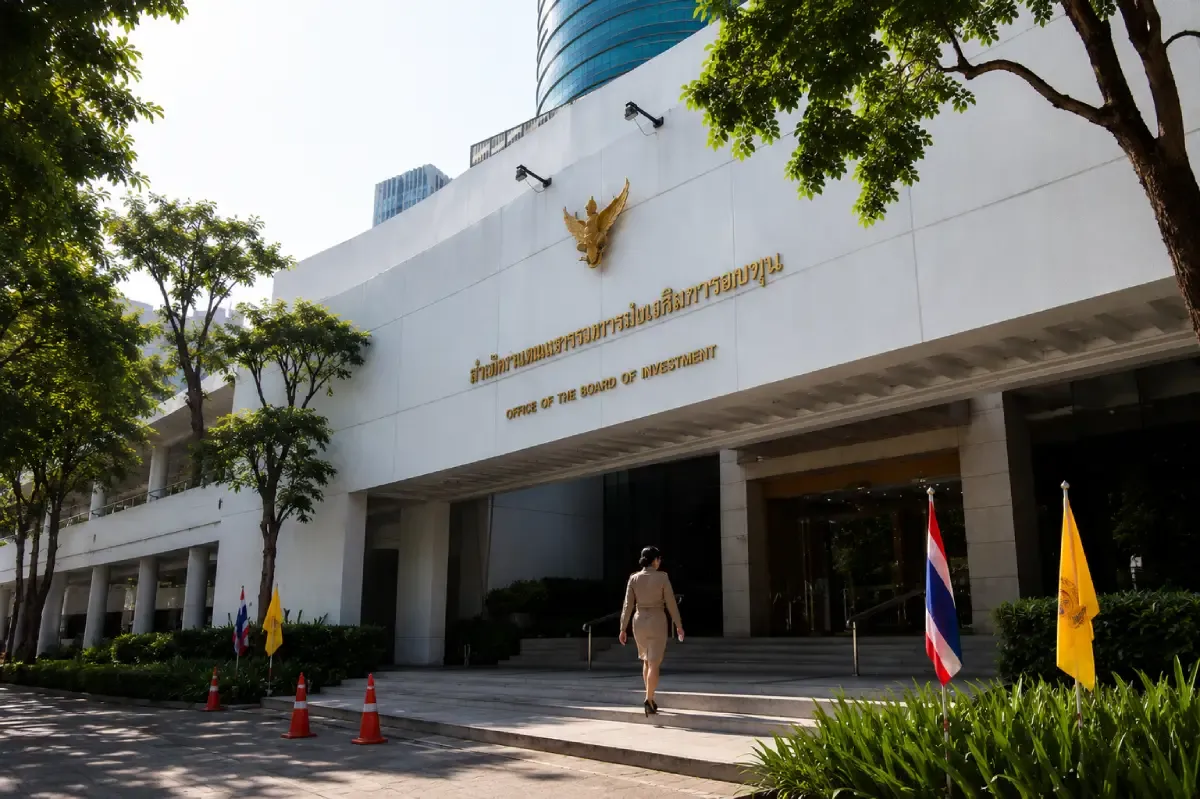
- BOI promotion: the Thailand Board of Investment grants full foreign ownership plus tax incentives to companies in promoted industries. Application takes 2 to 4 months.
- Foreign Business Licence (FBL): available for List 2 and List 3 activities, but approval is discretionary and requires demonstrating economic contribution to Thailand. Minimum paid-up capital is THB 3 million per restricted activity.
- US-Thai Treaty of Amity: American citizens and US-incorporated companies can hold up to 100% in most sectors. Communications, transport, fiduciary functions, deposit-taking banking, land and natural resources, and domestic trade in indigenous agricultural products are excluded. Read more on our US-Thai Treaty of Amity page.
With effect from 28 August 2026, Thailand exempted eight service activities (including Type 1 telecommunications, treasury centres and certain intra-group administrative, HR and IT services) from the FBA’s licensing requirement, expanding the activities foreign-majority companies can operate in without an FBL. A ninth, agricultural futures trading, awaits a Royal Decree. If your sector was previously restricted, it is worth checking whether the rules have changed; Plizz can verify this for you as part of pre-incorporation planning.
Step 3: The 7-step registration process via DBD Biz Regist
Since 1 July 2026, all new company registrations in Thailand must be filed through the DBD Biz Regist online platform; paper forms are no longer accepted. The platform supports electronic signatures and identity verification through ThaID for Thai citizens or the DBD e-Service application for foreign nationals, who can also verify in person before a DBD registrar.
Here is the end-to-end process for a Thai private limited company:
- Reserve your company name.Submit up to three name options (in order of preference) through DBD Biz Regist. The DBD checks each name against existing registrations and naming guidelines. Approval typically takes 1 to 3 working days. The reserved name is valid for 30 days, so do not start this step until you are ready to file the rest.
- Prepare the Memorandum of Association (MOA).The MOA is the founding document and must include the company name, the registered office address (at province level), the company’s objectives, the registered share capital and division into shares, and the names of at least two promoters with the number of shares each subscribes to. Since February 2023, the minimum number of promoters and shareholders is two, not three, as older guides still claim.
- File the MOA with DBD.Submit the MOA through DBD Biz Regist with electronic signatures. The MOA registration fee is THB 500 plus stamp duty.
- Hold the statutory meeting.All shareholders meet (in person, by proxy, or by approved electronic means) to approve the Articles of Association, appoint directors and an auditor, allocate shares, and approve any expenses incurred by the promoters during incorporation. At least 25% of the par value of each share must be paid up at this point.
- Submit the company registration application.Within three months of the statutory meeting, file the full registration application (including the AOA, statutory meeting minutes, list of shareholders, director details, and proof of paid-up capital) through DBD Biz Regist. DBD registration fees depend on the registered capital; your Plizz quote lists the exact government fees.
- Receive your certificate of incorporation.If your application is in order, the DBD usually reviews and approves it within a few working days of submission; files with foreign shareholders or directors can take longer. Your company now legally exists and has a 13-digit registration number that doubles as its tax ID.
- Register for tax and post-incorporation requirements.After incorporation, you need to register for VAT if applicable, register with the Social Security Office once you hire your first employee, and open a corporate bank account. We cover this in more detail below.
From start to finish, a straightforward registration on DBD Biz Regist completes in 5 to 15 working days, assuming all your documents are ready and there are no issues with your name reservation or shareholder verification. Foreign-majority structures and BOI applications take longer.
Step 4: Costs and timelines you should actually budget for
There are two cost categories to plan for: government fees (small and predictable) and professional fees (the bigger line item). Then there are paid-up capital requirements, which are not technically fees (they are money your company keeps), but they tie up cash you need to inject upfront.
Government fees (DBD)
| Item | Government fee (THB) | Notes |
|---|---|---|
| Company name reservation | Free | Submitted via DBD Biz Regist |
| Memorandum of Association (MOA) | 500 | Flat fee |
| Company registration fee | 5,000 | Flat fee, regardless of registered capital |
| Stamp duty | 200 | Flat fee |
| Certificate of incorporation | 200 | Flat fee |
| Company affidavit (per page) | 100 | Issued post-registration |
| Typical total (THB 1m capital) | ≈ 6,500–7,500 | Government fees only; excludes professional fees |
Paid-up capital requirements
The minimum registered capital for a Thai private limited company is technically THB 10 (two shares at the THB 5 minimum par value). In practice, several factors push the realistic minimum much higher:
- Per work permit for a foreign employee:THB 2 million in fully paid-up registered capital is required by the Department of Employment for each work permit issued to a non-Thai. If you plan to sponsor two foreign work permits, you need THB 4 million paid up.
- Foreign-majority companies operating restricted activities:THB 3 million per restricted activity, paid up, before operations begin.
- Banking and credibility:most Thai banks expect to see at least THB 1 million in registered capital before opening a corporate account for a foreign-owned business.
Professional fees
Plizz handles standard private limited company registration starting from THB 29,900. That covers name reservation, MOA preparation, statutory meeting documentation, DBD Biz Regist filing, and the certificate of incorporation. Independent law firms in Bangkok typically quote THB 30,000 to THB 80,000 for the same scope. BOI applications and FBL applications cost more because they require detailed business plans and back-and-forth with regulators.
Realistic timeline
- Standard Thai private limited company:5 to 15 working days from name reservation to certificate of incorporation.
- Foreign-majority company under FBL:3 to 6 months including FBL approval.
- BOI-promoted company:2 to 4 months for BOI approval, plus 2 to 3 weeks for company incorporation afterwards.
- Branch office or representative office:2 to 3 months including head office documentation and ministerial approval.
Step 5: What to do in your first 60 days after incorporation
Getting the certificate of incorporation is not the finish line. The first 60 days are when most foreign entrepreneurs trip up, because Thai compliance has a layered structure of registrations spread across three different government agencies. Here is the post-incorporation checklist.
- Corporate income tax.Your company registration number doubles as your tax ID, so you do not need a separate tax ID application. Corporate income tax is 20% of net profit; SMEs with paid-up capital of up to THB 5 million and revenue of up to THB 30 million pay 0% on the first THB 300,000, 15% on THB 300,001 to 3 million and 20% above that.
- Register for VAT (if applicable).VAT registration is mandatory within 30 days of your annual revenue exceeding THB 1.8 million. Voluntary registration is also available below the threshold and is often advisable; in practice it is expected when you apply for foreign work permits and by many corporate and government clients. The standard VAT rate is 7%.
- Open a corporate bank account.Major Thai banks (Bangkok Bank, Kasikornbank, SCB, Krungsri) all offer business accounts. Bring your certificate of incorporation, MOA, list of shareholders, board resolution authorising the account, director identification, and proof of registered office. Some banks insist on the director appearing in person.
- Register with the Social Security Office.Required within 30 days of hiring your first employee. Both employer and employee contribute 5% of the employee’s monthly salary (capped at THB 875 each per month since the wage ceiling rose to THB 17,500 on 1 January 2026) to the Social Security Fund.
- Set up bookkeeping and appoint an auditor.Thai law requires every company to maintain proper accounting records, file monthly and annual tax returns, and submit audited financial statements to the DBD each year. Audit is mandatory regardless of company size. Appoint a qualified accountant from day one: late filings carry penalties starting at THB 2,000 per missed deadline. See how Plizz handles
- Apply for visas and work permits.Foreign directors and employees need a Non-Immigrant B visa and a work permit before working legally in Thailand. The company must meet the THB 2 million capital-per-permit threshold and maintain four Thai employees per foreign work permit (with exemptions for BOI companies).
- Set up payroll and withholding tax compliance.Once you hire staff, you are responsible for monthly personal income tax withholding, social security contributions, provident fund contributions if you offer one, and supplier withholding tax on professional services and rental payments. Plizz offers
- →payroll outsourcing and withholding tax compliance for both.
Common mistakes foreign entrepreneurs make
Across hundreds of incorporations Plizz has handled for foreign entrepreneurs, the same handful of avoidable mistakes come up repeatedly. Here are the ones to watch for.
- Underestimating paid-up capital.Founders frequently register with THB 1 million capital and then realise three months later they need work permits requiring THB 2 million. Capital increases mid-stream are possible but require a shareholder resolution, additional DBD filings, and a new round of bank evidence. Plan capital correctly upfront.
- Using nominee shareholders.It is tempting to find a Thai friend or staff member to “hold” 51% on your behalf. This is a criminal offence, and the 2026 enforcement crackdown, including bank statement requirements, has made it materially riskier than even two years ago.
- Choosing a registered address you cannot prove.Your company’s registered address must be a real location with a lease agreement or property document in the company’s name (or with permission from the property owner). Virtual addresses without proper documentation cause registration rejections and tax audit problems later.
- Skipping VAT registration when you should not.Voluntary VAT registration is usually the right call if you have any business-to-business clients, because they will expect tax invoices. Waiting until you cross the THB 1.8 million threshold often means refiling several months of invoices retroactively.
- Treating accounting as an afterthought.Thai monthly tax filings (PND.1, PND.3, PND.53, PP.30) and social security submissions are unforgiving on deadlines. Late filings compound quickly. Engage a certified accountant from month one, not month six when you receive your first penalty notice.
- Forgetting that the company year-end matters.Most companies default to a 31 December financial year-end, but you can choose differently if it suits your business cycle. Audited financial statements must be filed within five months of year-end. Choose the wrong date and you may end up with audit deadlines competing with your busiest trading season.
How Plizz handles your company registration
Plizz has registered hundreds of Thai private limited companies, BOI-promoted companies, branch offices, and US Treaty of Amity companies for foreign entrepreneurs since 2015. We are certified by the Federation of Accounting Professions of Thailand and were a 2017 Thailand Startup Award winner. What makes us different from a traditional Thai law firm:
- Fixed, published pricing.Standard private limited company registration starts at THB 29,900, with no hidden fees. You know what you are paying before you start.
- One firm, every service.Company registration, monthly accounting, payroll, VAT registration, work permits, BOI applications, and corporate secretary all under one roof. You do not need to coordinate three different providers when you scale.
- Built for foreign entrepreneurs.Full English-language service from a team that has handled clients from Singapore, the UK, the US, Hong Kong, Australia, and India, and knows what each nationality’s common questions and tax overlaps look like.
- Online-first platform.Submit information, sign documents, and access your financial reports 24/7 through the Plizz online platform. We handle the trips to government offices for you.
If you are ready to register your company in Thailand, contact Plizz to start your company registration and we will scope your structure, capital, and timeline before you commit.
Frequently asked questions
How long does it take to register a company in Thailand in 2026?
A standard Thai private limited company filed through DBD Biz Regist takes 5 to 15 working days from name reservation to receiving the certificate of incorporation, assuming all documents are in order. BOI applications take 2 to 4 months on top of incorporation, and Foreign Business Licence applications take 3 to 6 months.
What is the minimum capital needed to register a company in Thailand?
The legal minimum is THB 10, but the practical minimum depends on your situation. If you need to sponsor a foreign work permit, the Department of Employment requires THB 2 million in paid-up capital per permit. Foreign-majority companies operating restricted activities need at least THB 3 million. Most Thai banks expect to see at least THB 1 million before opening a corporate account.
Can a foreigner own 100% of a Thai company?
Not in a standard private limited company without an exemption. Foreign ownership in standard companies is capped at 49%. Full foreign ownership is possible through BOI promotion (for promoted industries), a Foreign Business Licence (for List 2 and List 3 activities, with discretionary approval), the US-Thai Treaty of Amity (for US citizens and US-incorporated companies), or by qualifying for one of the FBA-exempted activity categories such as export manufacturing.
How many shareholders do I need to register a Thai company?
Two. Since the Civil and Commercial Code amendment that took effect on 7 February 2023, the minimum number of promoters and shareholders for a Thai private limited company is two, reduced from the previous requirement of three. Older guides still cite three, but they are out of date.
Do I need a Thai director to register my company?
No. There is no legal requirement for a Thai national to sit on the board of a Thai company. However, in practice many banks and government agencies prefer to see at least one Thai resident director, and a local director is often required for visa sponsorship and some licence applications.
What is DBD Biz Regist and do I have to use it?
DBD Biz Regist is the Department of Business Development’s online registration platform. It is now the only channel for registering a private limited company in Thailand; paper filings are no longer accepted. Foreign nationals verify their identity through the DBD e-Service application or in person before a DBD registrar; Thai citizens can also use ThaID or NDID.
How much does it cost to register a company in Thailand?
Government fees for a standard private limited company with THB 1 million in registered capital total approximately THB 6,500 to THB 7,500. Professional fees for using a registration service like Plizz start at THB 29,900. The bigger budget item is paid-up capital itself, which depends on whether you need work permits and whether your business is foreign-majority in a restricted activity.
Ready to register your company in Thailand?
Setting up a company in Thailand in 2026 is faster than ever, thanks to DBD Biz Regist. But “faster” does not mean “simpler”: the structure you choose, the foreign ownership route you take, the capital you commit, and the post-incorporation registrations you complete all carry consequences that are easier to get right the first time than to fix later.
Plizz handles every step from name reservation through to your first VAT return, with fixed monthly pricing and a team that has helped hundreds of foreign entrepreneurs build legitimate, compliant Thai businesses since 2015. Talk to Plizz about your company registration and get your business set up correctly from day one.
Official sources referenced in this guide
- Department of Business Development (DBD): primary regulator for company registration.
- Thailand Board of Investment (BOI): investment promotion and BOI application authority.
- Revenue Department of Thailand: corporate income tax, VAT, and withholding tax.
How Plizz can help
Related services
- Thai Limited CompanyRegister a Thai private limited company, from name reservation to tax ID and VAT. View service and prices
- Foreign Business LicenseApply for a Foreign Business License to operate restricted activities in Thailand. View service and prices
- Government RegistrationsVAT, social security and other government registrations for your company. View service and prices