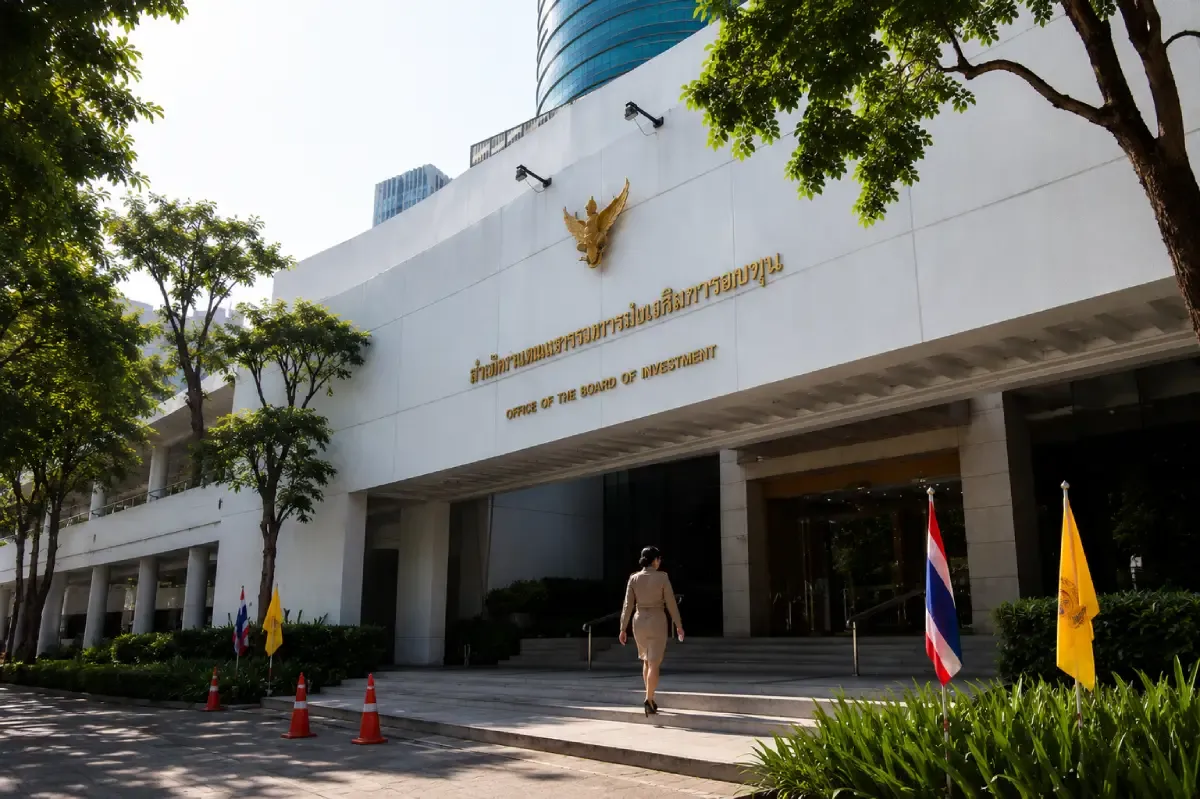
Owning a Thai Company as a Foreigner in 2026: 49/51, FBL, BOI or Treaty of Amity
49/51, Foreign Business License, BOI or Treaty of Amity: which route fits you in 2026, what each one costs, and what the new DBD Order 2/2569 changes for Thai shareholders.
“Can I own a company in Thailand?” is the question we answer most often at Plizz. Most of these emails come from founders and regional teams who have already read three websites and got three different answers. One says 49% is the limit. Another says a Thai friend can hold the other 51%. A third says 100% is easy with the right paperwork.
All three contain some truth, and in 2026 the gap between them matters more than ever. Since 1 August 2026, the Department of Business Development (DBD) asks Thai shareholders in foreign-linked companies to prove they really paid for their shares. The old shortcut of “Thai partners who do not invest” no longer gets through registration.
This guide compares the four legal routes for a foreigner who wants to own a business in Thailand: a Thai company with foreign minority ownership, a Foreign Business License (FBL), BOI promotion, and the US-Thai Treaty of Amity. For each one you will see who it suits, how much capital it needs, how long it takes and what it costs, followed by the work permit rules that come with every route.
The starting point: the 49% rule
The Foreign Business Act (FBA) of 1999 treats a company as “foreign” when foreigners hold half or more of its shares. A foreign company may not run the activities listed in the Act without permission. Those lists are wide:
- List 1: activities closed to foreigners for special reasons, such as rice farming, land trading and newspapers. There is no licence route.
- List 2: activities linked to national security, culture and natural resources. These need Cabinet approval.
- List 3: activities in which Thai businesses are “not yet ready to compete”. This list catches most service businesses, including consulting, marketing, most retail and wholesale below the FBA thresholds, restaurants and tour operators.
In practice, a foreign founder who wants to sell services in Thailand will almost always fall under List 3. You then have four options: stay below 50% foreign ownership, get a licence, get BOI promotion, or use the Treaty of Amity if you are American.
The four routes at a glance
| Route | Who it suits | Foreign ownership | Minimum capital | Typical timeline | Plizz fee |
|---|---|---|---|---|---|
| Thai company, foreign minority | Founders with Thai partners who genuinely invest | Up to 49% | No FBA minimum. THB 2 million paid up per work permit | 2 to 4 weeks to register | THB 50,000, plus about THB 7,000 government fees |
| Foreign Business License (List 3) | Service businesses that want full control | Up to 100% | THB 3 million per licensed activity, fully paid up | 60 days of official review after a complete file, several months overall | From THB 15,000 for the assessment, plus company registration |
| BOI promotion | Activities on the BOI list: tech, digital, manufacturing, regional HQ and more | Up to 100% | Investment of at least THB 1 million, excluding land and working capital, for most activities | 40 to 90 working days of review, plan for about 6 months | From THB 20,000 for the assessment, plus company registration |
| US-Thai Treaty of Amity | US citizens and US-majority companies | Up to 100% | No treaty minimum. FBA capital rules still apply | About 2 to 4 months, including US Embassy certification | THB 40,000, plus company registration |
All Plizz fees exclude 7% VAT. Full details are on our pricing page, and the online quote builder adds up the setup and monthly costs for your situation.
Route 1: a Thai company with foreign minority ownership (49/51)
This is still the most common structure in Thailand. A Thai private limited company needs at least two shareholders. If Thai shareholders hold at least 51%, the company is Thai under the FBA, so it can run List 3 activities without a licence and has no FBA minimum capital.
It suits you when you have Thai partners who bring their own money and want to be part of the business: a Thai spouse who co-invests, a Thai co-founder, or a Thai company that takes a real stake.
It does not suit you when the Thai shareholders are there only on paper. That has always been illegal, and since August 2026 it is also much harder to register.
What changed on 1 August 2026: DBD Order No. 2/2569
The Central Partnership and Company Registration Office issued Order No. 2/2569 on 14 July 2026. It took effect on 1 August 2026 and replaced the earlier orders 2/2568 and 1/2569. It applies when you register a new partnership or company in which:
- a foreigner holds less than 50% of the capital, or
- there is no foreign shareholder, but a foreigner is an authorised director.
For these registrations, the DBD now asks for:
- an investment explanation letter on the DBD form;
- a bank statement for each Thai shareholder covering the three months before they paid for their shares;
- a bank statement showing the company or managing director receiving that capital, with amounts and dates that match the registration documents.
Similar evidence is required when a foreign director or foreign shareholder is added to a company that is less than one year old. For older companies, a confirmation letter is required.
What this means in practice: if your Thai shareholders cannot show that the money for their 51% came from their own accounts, the registration will stall. The emails we receive show the same pattern again and again: “my Thai friends will hold 51% but they won't invest”. That plan no longer works, and it was never safe.
The nominee risk
Under Section 36 of the FBA, a Thai person who holds shares on behalf of a foreigner, and the foreigner who uses them, face up to three years in prison, a fine of THB 100,000 to 1,000,000, or both. The court can also order the business to stop, with a daily fine of THB 10,000 to 50,000 until it does. Our article on avoiding Thai nominees explains how these cases come to light, often through a dispute between partners or a bank's compliance review.
Keeping a say at 49%
Being a minority shareholder does not mean having no influence. Legitimate tools include a seat on the board with signing authority, a shareholders' agreement that sets out reserved matters and exit terms, and different share classes in the Articles of Association. What the law does not allow is a structure in which Thai shareholders take no risk, put in no money of their own and only sign documents. If you also need land for the business, read how foreigners lease land in Thailand: a foreign-majority company cannot own land, and a Thai company used to hold it is a nominee offence. When in doubt, ask our partner law firm Narai Partners to review the shareholding before you register.
Route 2: the Foreign Business License
The FBL lets a foreign-majority company run a List 3 activity (or a List 2 activity, with Cabinet approval). It is the main route to 100% ownership for consulting, agency, software services, trading and similar businesses that do not qualify for BOI.
- Capital: THB 3 million per licensed activity, fully paid up and supported by a bank certificate before the licence is issued. Two licensed activities means THB 6 million. The general THB 2 million minimum for foreign companies does not apply to activities on the FBA lists.
- Timeline: the law gives the authorities 60 days to decide once the file is complete. In practice, add the time to register the company, pay in the capital and prepare the business plan, and expect questions from the Foreign Business Committee.
- Government fees: THB 2,000 to apply. For List 3, the licence fee is THB 5 per THB 1,000 of registered capital, with a minimum of THB 20,000 and a maximum of THB 250,000.
- What the committee looks for: real benefit to Thailand, usually Thai jobs, training and technology transfer, and a clear activity scope that does not stray into List 1.
Read more on our Foreign Business License page, including the most common reasons applications are sent back.
Route 3: BOI promotion
If your activity is on the Board of Investment's list of promoted activities, BOI promotion is usually the best deal in Thailand. You get 100% foreign ownership without an FBL, the right to own land for the promoted activity, faster work permits through the One Start One Stop Investment Center, and in many categories several years of corporate income tax exemption.
- Investment: at least THB 1 million for most activities, not counting land and working capital. Some activities set higher thresholds.
- Timeline: the BOI reviews projects of up to THB 200 million in about 40 working days, larger projects in 60 to 90 working days. Including preparation and questions, plan for around six months.
- Obligations: you must keep the conditions of your certificate, file the BOI's progress and annual reports, and keep promoted and non-promoted income apart in your accounts.
BOI is not a shortcut for a small trading or consulting company. It works when your activity really fits a promoted category. Our BOI application guide walks through the process step by step, and the BOI company page lists the fees.
Route 4: the US-Thai Treaty of Amity
American citizens, and companies that are majority owned by Americans, can hold up to 100% of a Thai company in most activities without an FBL. The company must be more than half owned by US citizens. Green card holders do not qualify unless they are also US citizens.
- Excluded activities: communications, transport, banking and fiduciary services, the exploitation of natural resources, land ownership and domestic trade in agricultural products.
- Capital: the treaty adds no capital rule of its own. The FBA capital rules for foreign companies still apply.
- Process: register the Thai company, obtain the US Embassy certification, then apply for the Foreign Business Certificate with the DBD. Plan for about two to four months.
See our Treaty of Amity page for the full process.
Work permits and visas: the rules that come with every route
Owning a company does not give you the right to work in it. Every foreigner who works in Thailand, including the owner, needs a work permit and usually a Non-Immigrant B visa. For a regular company, the Department of Employment generally expects:
- THB 2 million of paid-up capital per work permit. Two foreign employees means THB 4 million. The requirement is halved for a foreigner married to a Thai national.
- Four Thai employees per foreign worker, registered with social security.
- An office, payroll, and monthly tax and social security filings that show the company is really operating.
This is why the capital of your company matters even when the FBA does not set a minimum. A 49/51 company registered with THB 1 million will need a capital increase before its foreign director can get a work permit.
BOI-promoted companies are treated differently: they are not bound by the 4 to 1 ratio, and their foreign staff quota is set when the project is approved.
Plizz handles the visa and work permit as a bundle for THB 35,000, and the 90-day reports for THB 6,000 a year.
What the first year really costs
Prospects often ask us for “the full cost, including year two”. Here is an example for a common case: a services company with one foreign director and four Thai staff, set up as a Thai company with a foreign minority shareholder.
| Item | Plizz fee (THB, excluding VAT) |
|---|---|
| Company registration (government fees of about THB 7,000 extra) | 50,000 |
| Corporate bank account opening | 10,000 |
| VAT registration | 20,000 |
| E-filing registrations with the DBD, Revenue Department and Social Security Office (THB 3,000 each) | 9,000 |
| Non-B visa and work permit for the director | 35,000 |
| One-time total | 124,000 |
| Bookkeeping and monthly tax filings, up to 50 transactions a month | 14,900 a month |
Add the payroll service if you outsource payroll, the annual audit that every Thai company needs, and the THB 2 million of paid-up capital for the work permit, which stays in the company as working capital. For an FBL, add the THB 3 million capital requirement and the licence fees. For BOI, add the application work and the reporting that follows.
Which route fits you?
- You have a Thai partner who invests real money: a Thai company with foreign minority ownership is the fastest and cheapest route.
- You are American: look at the Treaty of Amity first, unless your activity is excluded.
- Your activity is on the BOI list: BOI promotion gives you 100% ownership plus tax and visa benefits. Check eligibility before you register anything.
- You want 100% of a service business and BOI does not fit: plan for an FBL, with THB 3 million of capital per activity and time for the application.
- You only need to employ one or two people in Thailand for a foreign company: an employer of record or a representative office may be simpler than a full company. Ask us before you commit.
Frequently asked questions
Can a foreigner own 100% of a company in Thailand?
Yes, through an FBL, BOI promotion or the Treaty of Amity for Americans. Activities that are not on the FBA lists, such as most manufacturing, can also be 100% foreign owned with THB 2 million of capital.
Can my Thai friends hold 51% if they do not invest?
No. That is a nominee arrangement under the FBA, and since 1 August 2026 the DBD asks for bank statements showing that Thai shareholders paid for their shares.
Do I really have to pay in THB 2 million?
If you want a work permit, yes: the Department of Employment looks at paid-up capital, not just registered capital. The money stays in the company and can be used for its business.
Does DBD Order 2/2569 affect my existing company?
It applies to new registrations and to changes such as adding a foreign director or shareholder. If your company is less than a year old, the full evidence is required for those changes. Older companies file a confirmation letter.
How long does it take to start trading?
A Thai company can be registered in two to four weeks, but the bank account, VAT registration and work permit take longer. Most founders are fully operational within two to three months. FBL and BOI routes take several months more.
How Plizz can help
Plizz has registered and run companies for foreign founders in Thailand since 2015, and our sister law firm Narai Partners handles the legal side, from shareholders' agreements to FBL and BOI applications. We start by classifying your activity, so you know which route applies before you put in any capital. After that, the same team handles your registration, bank account, visa, work permit, bookkeeping and tax filings, at published prices.
Build your setup cost in two minutes with our online quote, or ask us in writing and get an answer within one business day.
How Plizz can help
Related services
- Thai Limited CompanyRegister a Thai private limited company, from name reservation to tax ID and VAT. View service and prices
- Foreign Business LicenseApply for a Foreign Business License to operate restricted activities in Thailand. View service and prices
- BOI PromotionBOI applications for tax holidays, 100% foreign ownership and work permit support. View service and prices